and began reading on Hindu deities.
I especially found Shiva, god of fertility and destruction interesting. I was going to write a description/summary of him, but found this really great one online in the midst of searching images of said.
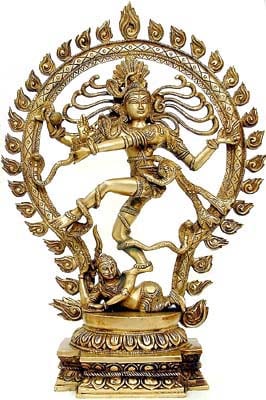 Shiva the Hindu god of destruction is also known as Nataraja, the Lord of Dancers (In Sanskrit Nata means dance and raja means Lord). The visual image of Nataraja achieved canonical form in the bronzes cast under the Chola dynasty in the tenth century AD, and then continued to be reproduced in metal, stone and other substances right up to the present times. The Chola Nataraja is often said to be the supreme statement of Hindu art.
To understand the concept of Nataraja we have to understand the idea of dance itself. Like yoga, dance induces trance, ecstasy and the experience of the divine. In India consequently, dance has flourished side by side with the terrific austerities of the meditation grove (fasting, absolute introversion etc.). Shiva, therefore, the arch-yogi of the gods, is necessarily also the master of the dance.
These iconographic details of Nataraja are to be read, according to the Hindu tradition, in terms of a complex pictorial allegory:

The most common figures depict a four-armed Shiva. These multiple arms represent the four cardinal directions. Each hand either holds an object or makes a specific mudra (gesture).
The upper right hand holds a hour-glass drum which is a symbol of creation. It is beating the pulse of the universe. The drum also provides the music that accompanies Shiva’s dance. It represents sound as the first element in an unfolding universe, for sound is the first and most pervasive of the elements. The story goes that when Shiva granted the boon of wisdom to the ignorant Panini (the great Sanskrit grammarian), the sound of the drum encapsulated the whole of Sanskrit grammar. The first verse of Panini’s grammar is in fact called Shiva sutra.
The hour-glass drum also represents the male and female vital principles; two triangles penetrate each other to form a hexagon. When they part, the universe also dissolves.

The opposite hand, the upper left, bears on its palm a tongue of flames. Fire is the element of destruction of the world. According to Hindu mythology at the end of the world, it will be fire that will be the instrument of annihilation. Thus in the balance of these two hands is illustrated a counterpoise of creation and destruction. Sound against flames, ceaselessness of production against an insatiate appetite of extermination.
The second right hand is held in the abhaya pose (literally without fear) and so a gesture of protection, as an open palm is most likely to be interpreted. It depicts the god as a protector.
 The left leg is raised towards the right leg and reaches across it; the lower left hand is stretched across the body and points to the upraised left foot which represents release from the cycle of birth and death. Interestingly, the hand pointing to the uplifted foot is held in a pose imitative of the outstretched trunk of an elephant. In Sanskrit this is known as the ’gaja-hasta-mudra’ (the posture of the elephant trunk), and is symbolic of Ganesha, Shiva’s son, the Remover of obstacles.
Shiva dances on the body of a dwarf apasmara-purusha (the man of forgetfulness) who embodies indifference, ignorance and laziness. Creation, indeed all creative energy is possible only when the weight of inertia (the tamasic darkness of the universe) is overcome and suppressed. The Nataraja image thus addresses each individual to overcome complacency and get his or her own act together.
The ring of fire and light, which circumscribes the entire image, identifies the field of the dance with the entire universe. The lotus pedestal on which the image rests locates this universe in the heart or consciousness of each person.
The Nataraja image is also eloquent of the paradox of Eternity and Time. It shows us that the reposeful ocean and the racing stream are not finally distinct. This wonderful lesson can be read in the significant contrast of the incessant, triumphant motion of the swaying limbs to the balance of the and the immobility of the mask-like countenance. Shiva is Kala, meaning time, but he is also Maha Kala, meaning “Great Time” or eternity. As Nataraja, King of dancers, his gestures, wild and full of grace, precipitate the cosmic illusion; his flying arms and legs and the swaying of his torso produce the continuous creation-destruction of the universe, death exactly balancing  birth. The choreography is the whirligig of time. History and its ruins, the explosion of suns, are flashes from the tireless swinging sequence of the gestures. In the beautiful cast metal figurines, not merely a single phase or movement, but the entirety of this cosmic dance is miraculously rendered. The cyclic rhythm, flowing on and on in the unstayable, irreversible round of the Mahayugas, or Great Eons, is marked by the beating and stamping of the Master’s heels. But the face remains, meanwhile in sovereign calm.
The Nataraja image represents not simply some event in the mythic life of a local deity but a universal view in which the forces of nature and the aspirations and limitation of man confront each other and are blended together. The curator of the Indian collection of the Metropolitan Museum of Art has rightly written that: "If one had to select a single icon to represent the extraordinarily rich and complex cultural heritage of India, the Shiva Nataraja might well be the most remunerative candidate."
Full article: http://www.exoticindiaart.com/article/nataraja/