At least a little bit.
You might have heard of the Myers-Briggs personality type indicator. It is mostly based on Carl Jung's (dream guy/psychoanalyst) findings. You can take the test http://www.mypersonality.info/ there.
Once you have done so, or you already know what personality type you are, I have scanned some papers provided by my psych teacher for some more information.
http://www.box.net/shared/fxneej5jry
http://www.box.net/shared/ppge9xvobj
^These PDFs briefly break down what each thing means, and what they prefer.
http://www.box.net/shared/qya07qxkza
^"Mutual Usefulness of the Opposites"
Basically, what the opposite personality type seeks from you and what you seek from there.
http://www.box.net/shared/4al2otfia0
^Management/Leadership types
This test is in no way supposed to limit you in any way. I am an INTP, and do not only behave in the way that characterizes an INTP. In fact, I have used these results to further develop my extroverted side.
Showing posts with label psychology. Show all posts
Showing posts with label psychology. Show all posts
Sunday, May 9, 2010

Monday, April 26, 2010
Dreams, yet again
Perhaps I've already stressed enough the importance of dreams, but here is an article by the BBC for the interested.
http://news.bbc.co.uk/2/hi/health/8638551.stm
It doesn't add on much from what I have already shared.
http://news.bbc.co.uk/2/hi/health/8638551.stm
It doesn't add on much from what I have already shared.
Saturday, January 30, 2010
Conditioning and Schedules of Reinforcement
Different types of conditioning and using the movie Rain Man for examples.
Operant conditioning creates a thinking response.
examples:
examples:
examples (not from Rain Man):
fixed ratio: certainty of reward for a patter or behavior
Operant conditioning creates a thinking response.
examples:
- Charlie takes maple syrup to the diner each time for breakfast, or else Raymond would throw a fit.
- Charlie buys Raymond a portable television, so Raymond won't miss his shows.
examples:
- Raymond brushes his teeth a certain amount of times each morning.
- Raymond gets to watch TV after he does his routine.
- Charlie repeats things like an autistic person would. He learns this from Raymond from when they were kids. An example is when Charlie repeatedly says, "I got the rose bush!"
- Raymond tries to dance after seeing the people dance on TV.
- Raymond mimmicks Susana's moans.
- Raymond copies the motor sounds of the car on the bridge.
examples (not from Rain Man):
- Susie had a great time at Disneyland. When Susie thinks of Disney related things, she becomes happy.
fixed ratio: certainty of reward for a patter or behavior
- Each time the student studies, the student gets an A.
- Each time the player makes a goal, the student receives a high-five.
- Every night at 6pm, he eats dinner.
- Every Friday night, she gets to go out.
- She doesn't know how many times a week she had to do the dishes to get an allowance.
- The child's parents sometimes give him a cookie after he recites the ABCs.
- The fisherman doesn't know for how much time he has to wait until a fish comes along and takes the bait.
Thursday, January 7, 2010
Psychology: Development according to Erik Erikson
Why are some people more mistrustful of others? Why do some 50 year-olds still have self-identity issues? Why are 30 year-olds still compromising their values? Behaviorist Erik Erikson lays it out for us in these different stages of development. According to Erikson, if you did not pass the threshold of each stage at the given age, you will have a harder time transcending it later on.
Trust vs. Mistrust 0-18 months old
It is to no surprise that babies emit an alluring scent that attracts people to them. People who were bereft of the close care and attention of a parent during this critical age turn out to be mistrusting of other people throughout their life. They also feel uncomfortable to the touch of other people. Who would of thought? Love for your baby is the key to this stage.
Autonomy vs. Doubt 9-18 months old
I have seen it too many times; parents complaining about their one year old getting dirty and sticking things in their mouth. They keep their child in a nice, neat bubble in front of the television to prevent them from getting too close to all the germs and dirt out in the world.What the parents do not realize is that they are setting up their child to be afraid of exploring. Autonomy is all about discovering, whether it be smelling new aromas, touching different textures, or hearing different sounds.(Hence wooden blocks, play-dough, etc.) Kids who grow up without autonomy will less likely take risks and doubt will refrain them from doing what they want. Parents, let your child crawl.
Initiative vs. Guilt 18 months-3 years old
This is around the time when kids start getting cheeky and want to do things their way. As long as it is not extremely hazardous to them or others, let them make decisions. This is the start of their leadership skills. Often the ones who were always or mostly denied now have misplaced guilt with the decisions they make. It may not be harmful to others, but they will feel as so. The best advice one could give to a parent is listen to your child for their needs. Bend down at their level, look at them in the eyes, and consider their suggestions.
Industry vs. Inferiority 5-12 years old
Elementary school teachers are not dumb. There is a motive to each sticker or award they give. A child needs to feel successful, and also need to feel in control over their body (physical education, anyone?). They need feel accomplished in reading, writing, and with numbers - which are the core fundamentals for a successful life in this society. Usually they are more successful also with problem solving.
Identity vs. Confusion 13-18 years old
I think the title is quite explicit. These are the years when you start realizing that there may or may not be a Heaven or Hell, or even something like what type of genres you are getting into. These are more of the abstract years. You start gaining a sense of self and questioning what was taught to you.
Intimacy vs. Isolation 18-25 years old
You just cannot stop thinking about that one person. So how do we exercise intimacy? We find a nurturing partner, a business partner, and possibly a roommate all in one person. We have a physical and a mental relationship with that same person. And, of course, emotional.
Generosity vs. Stagnation 25-40 years old
Erikson believed these are the years that people seek positive impact, so they start trying to make a difference through volunteering or other altruism. They also tend to seek new challenges.
Integrity vs. Despair 40+ years old
Integrity is to do the right thing even when no one is watching, it is to not deliberately harm others or self. It is to be loyal and have respect for oneself and others. Despair is what the person who does not feel fulfilled feels during their death bed. They have a lot of regrets and wished they had probably trusted more, taken action, explored the "if"s, and wished they had been less self-absorptive.
They all end up accumulating into self-actualization.Of course, it would be silly to think that any of these could not happen at any age. Some people gain a sense of self earlier than others, while other may not ever really achieve it. Same applies to the other stages.
Trust vs. Mistrust 0-18 months old
It is to no surprise that babies emit an alluring scent that attracts people to them. People who were bereft of the close care and attention of a parent during this critical age turn out to be mistrusting of other people throughout their life. They also feel uncomfortable to the touch of other people. Who would of thought? Love for your baby is the key to this stage.
Autonomy vs. Doubt 9-18 months old
I have seen it too many times; parents complaining about their one year old getting dirty and sticking things in their mouth. They keep their child in a nice, neat bubble in front of the television to prevent them from getting too close to all the germs and dirt out in the world.What the parents do not realize is that they are setting up their child to be afraid of exploring. Autonomy is all about discovering, whether it be smelling new aromas, touching different textures, or hearing different sounds.(Hence wooden blocks, play-dough, etc.) Kids who grow up without autonomy will less likely take risks and doubt will refrain them from doing what they want. Parents, let your child crawl.
Initiative vs. Guilt 18 months-3 years old
This is around the time when kids start getting cheeky and want to do things their way. As long as it is not extremely hazardous to them or others, let them make decisions. This is the start of their leadership skills. Often the ones who were always or mostly denied now have misplaced guilt with the decisions they make. It may not be harmful to others, but they will feel as so. The best advice one could give to a parent is listen to your child for their needs. Bend down at their level, look at them in the eyes, and consider their suggestions.
Industry vs. Inferiority 5-12 years old
Elementary school teachers are not dumb. There is a motive to each sticker or award they give. A child needs to feel successful, and also need to feel in control over their body (physical education, anyone?). They need feel accomplished in reading, writing, and with numbers - which are the core fundamentals for a successful life in this society. Usually they are more successful also with problem solving.
Identity vs. Confusion 13-18 years old
I think the title is quite explicit. These are the years when you start realizing that there may or may not be a Heaven or Hell, or even something like what type of genres you are getting into. These are more of the abstract years. You start gaining a sense of self and questioning what was taught to you.
Intimacy vs. Isolation 18-25 years old
You just cannot stop thinking about that one person. So how do we exercise intimacy? We find a nurturing partner, a business partner, and possibly a roommate all in one person. We have a physical and a mental relationship with that same person. And, of course, emotional.
Generosity vs. Stagnation 25-40 years old
Erikson believed these are the years that people seek positive impact, so they start trying to make a difference through volunteering or other altruism. They also tend to seek new challenges.
Integrity vs. Despair 40+ years old
Integrity is to do the right thing even when no one is watching, it is to not deliberately harm others or self. It is to be loyal and have respect for oneself and others. Despair is what the person who does not feel fulfilled feels during their death bed. They have a lot of regrets and wished they had probably trusted more, taken action, explored the "if"s, and wished they had been less self-absorptive.
They all end up accumulating into self-actualization.Of course, it would be silly to think that any of these could not happen at any age. Some people gain a sense of self earlier than others, while other may not ever really achieve it. Same applies to the other stages.
Tuesday, December 29, 2009
Psychology: On Perception
We see life through a window, and that window is our perception. As we age and gain new experiences and knowledge, our window opens more. We know that our perception gives us faulty images at times.We start off with
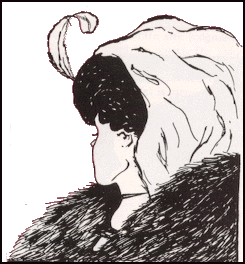
gestalt: when the surroundings of an object fool our perception.
So, it's not just the object itself, but the pattern around it, both visual and conceptual.
To the left is probably one of the most famous images of a gestalt. Take a closer look at it, what do you see? You should see two images. *You can view what it is at the end of the post.
 similarity: associating new things with already experienced things and grouping objects because of closeness in size, shape, or other prominent geometrical characteristics.
For example, at first look at the image to the right, we group the larger circles together. Instead of seeing the small circles and a large one vertically, we just clump the horizontal line of large circles.

For this image to the left, our initial glance categorizes the dots in horizontal lines, even though all the dots are equidistant.

proximity: distance, both physically and conceptually. For the image to the left, we automatically see two columns because there is a large gap between them. So we put things that are closer together.
We all know our perception is not always correct. A way proximity proves this is by looking at the image below. Which dot in the center is larger in size?

gestalt: when the surroundings of an object fool our perception.
So, it's not just the object itself, but the pattern around it, both visual and conceptual.
To the left is probably one of the most famous images of a gestalt. Take a closer look at it, what do you see? You should see two images. *You can view what it is at the end of the post.
similarity: associating new things with already experienced things and grouping objects because of closeness in size, shape, or other prominent geometrical characteristics.For example, at first look at the image to the right, we group the larger circles together. Instead of seeing the small circles and a large one vertically, we just clump the horizontal line of large circles.
For this image to the left, our initial glance categorizes the dots in horizontal lines, even though all the dots are equidistant.
We all know our perception is not always correct. A way proximity proves this is by looking at the image below. Which dot in the center is larger in size?
Our automatic response will want to say the dot in center on the left is larger. In fact, both centered dots are the same size. The proximity of the centered dot on the left to the smaller dots around it make it seem like it is bigger, whilst the centered dot on the right looks smaller due to the larger dots encompassing it.
closure: when your brain refrains from taking in new ideas and settles on one thing
A great movie that practices the use of different gestalts is Sling Blade. We watched it in my high school psych class and were assigned to find the different concepts of perception being used. Once you watch the movie this will make more sense. Closure happens when people automatically assume Karl is mentally deficient. Because of his poor social skills and symptoms of retardation, our brain automatically marks him as handicapped. Everything he does is perceived as something someone mentally ill would do. The similarity between him and Lenny from Of Mice and Men (someone who is actually mentally ill) makes it easier for the brain to close on him being handicap. There is plenty of more play with gestalt in the movie.
*The image is both of an old lady's face and a young lady turning her face to the right.
closure: when your brain refrains from taking in new ideas and settles on one thing
A great movie that practices the use of different gestalts is Sling Blade. We watched it in my high school psych class and were assigned to find the different concepts of perception being used. Once you watch the movie this will make more sense. Closure happens when people automatically assume Karl is mentally deficient. Because of his poor social skills and symptoms of retardation, our brain automatically marks him as handicapped. Everything he does is perceived as something someone mentally ill would do. The similarity between him and Lenny from Of Mice and Men (someone who is actually mentally ill) makes it easier for the brain to close on him being handicap. There is plenty of more play with gestalt in the movie.
*The image is both of an old lady's face and a young lady turning her face to the right.
Wednesday, December 23, 2009
The 6 Different Perspectives
Nurture

Social cultural
Fathers of the social cultural perspective are Sapir and Whorf. The linguistic relativity principle (also known as the Sapir-Whorf Hypothesis) is the idea that the varying cultural concepts and categories inherent in different languages affect the cognitive classification of the experienced world in such a way that speakers of different languages think and behave differently because of it.

Behavioral
The things we learn are due to positive and negative reinforcement. For example, I score a 100% on a quiz, so I receive a prize. The positive reinforcement is the prize. I fail the class, so I have to take it all over again. Having to retake the course is the negative reinforcement.
Humanistic
Humanists believe that humans have the desire to be better. Like, if a culprit witnesses an old lady being robbed, humanists believe that he will help her.
Nature
Psychoanalysis
The father of psychoanalysis is Sigmund Freud. He believed there to be the conscious and the unconscious in
 the human mind. The conscious consists of the Ego, Id, and Super-ego. The Id is our basic instincts of survival (Eros) and death (Thanatos). The Ego according to Freud "that part of the id which has been modified by the direct influence of the external world ... The ego represents what may be called reason and common sense, in contrast to the id, which contains the passions ... in its relation to the id it is like a man on horseback, who has to hold in check the superior strength of the horse; with this difference, that the rider tries to do so with his own strength, while the ego uses borrowed forces (Freud, The Ego and the Id)." The Super-ego is supposed to counteract what the Id does. The Id wants us to have sex with multiple partners, but the Super-ego reminds the person to act socially accepted.
Freud also believed that the purpose to everything we do is to reproduce. Just bought a new car? Well, unconsciously it's to get a step close to marry someone. Kind of like a male peacock showing of its vivid feathers.
Then along came Carl Gustav Jung. See my older posts on his views of dreams and I suggest reading up on the collective unconscious.
Bio-psychological
They basically believe that "bodily experiences, therefore, and more particularly brain-experiences, must take a place amongst those conditions of the mental life of which Psychology need take account. The spiritualist and the associationist must both be 'cerebralists,' to the extent at least of admitting that certain peculiarities in the way of working of their own favorite principles are explicable only by the fact that the brain laws are a codeterminant of their result. Our first conclusion, then, is that a certain amount of brain-physiology must be presupposed or included in Psychology."
Cognitive
This theory is that everything we learn and how we perceive the world is through hardwiring our brain.
Axon ---> Dentride
As you can probably tell, my favorite of these is psychoanalysis, also known as psychodynamics. I will post more about each perspective (or the ones I know about) in future psychology posts.
They basically believe that "bodily experiences, therefore, and more particularly brain-experiences, must take a place amongst those conditions of the mental life of which Psychology need take account. The spiritualist and the associationist must both be 'cerebralists,' to the extent at least of admitting that certain peculiarities in the way of working of their own favorite principles are explicable only by the fact that the brain laws are a codeterminant of their result. Our first conclusion, then, is that a certain amount of brain-physiology must be presupposed or included in Psychology."
Cognitive
This theory is that everything we learn and how we perceive the world is through hardwiring our brain.
Axon ---> Dentride
As you can probably tell, my favorite of these is psychoanalysis, also known as psychodynamics. I will post more about each perspective (or the ones I know about) in future psychology posts.
Murray's List of Psychological Needs
Murray thinks we need these in order to not suffer from neurosis.
I feel like agreeing with most of them, even if some seem a bit... out there. Some do need to be practiced in small dosages as they might hurt others, but they are still vital to one's needs so they must not be left in the dark. My quotidian example of each will be parenthesized.
acquisition to gain possessions and property
(Books. I love buying books.)
conservation to collect, repair, clean, and preserve things
(I like to take care keep good care of my possessions.)
order to arrange, organize, put away objects
(While I may seem messy, there is a certain organization to my things. I like having my clothes by color, books with most sentimental value higher on a shelf, etc.)
construction to organize and build
(I love making things for other people. Whether it be a juvenile painting, a mix-cd, or anything crafty.)
achievement to overcome obstacles, to exercise power, to strive to do something difficult, as well as quickly as possible
(I get good grades.)
recognition to excite praise and commendation
(I receive academic excellence awards.)
defendance to defend oneself against blame or belittlement
(Do this with my mom. q: )
dominance to influence or control others
(President of Key Club/Youth Ambassadors, Treasurer of SVC, editor of The Breeze, etc etc.)
autonomy to resist influence or coercion
( AKA I lay out my rules to my mom.)
aggression to assault or injure
(Playful jokes with friends, "Slug Bug" game, etc.)
affiliation to form friendships and associations
(Strong bond with a few people, network of friends from clubs and organizations, etc.)
rejection to snub, ignore, or exclude
(No, thanks.)
nurture to nourish, aid, or protect
(Four nephews, one niece, been an aunt since I was ten. I love helping others.)
succorance to seek aid, protection, or sympathy
(Do this often enough.)
play to relax, amuse oneself, seek diversion, and entertainment
(Learning the harmonica, drawing, painting, being silly, etc.)
cognizance to explore
(Reading, people watching, going places, etc.)
I feel like agreeing with most of them, even if some seem a bit... out there. Some do need to be practiced in small dosages as they might hurt others, but they are still vital to one's needs so they must not be left in the dark. My quotidian example of each will be parenthesized.
acquisition to gain possessions and property
(Books. I love buying books.)
conservation to collect, repair, clean, and preserve things
(I like to take care keep good care of my possessions.)
order to arrange, organize, put away objects
(While I may seem messy, there is a certain organization to my things. I like having my clothes by color, books with most sentimental value higher on a shelf, etc.)
construction to organize and build
(I love making things for other people. Whether it be a juvenile painting, a mix-cd, or anything crafty.)
achievement to overcome obstacles, to exercise power, to strive to do something difficult, as well as quickly as possible
(I get good grades.)
recognition to excite praise and commendation
(I receive academic excellence awards.)
defendance to defend oneself against blame or belittlement
(Do this with my mom. q: )
dominance to influence or control others
(President of Key Club/Youth Ambassadors, Treasurer of SVC, editor of The Breeze, etc etc.)
autonomy to resist influence or coercion
( AKA I lay out my rules to my mom.)
aggression to assault or injure
(Playful jokes with friends, "Slug Bug" game, etc.)
affiliation to form friendships and associations
(Strong bond with a few people, network of friends from clubs and organizations, etc.)
rejection to snub, ignore, or exclude
(No, thanks.)
nurture to nourish, aid, or protect
(Four nephews, one niece, been an aunt since I was ten. I love helping others.)
succorance to seek aid, protection, or sympathy
(Do this often enough.)
play to relax, amuse oneself, seek diversion, and entertainment
(Learning the harmonica, drawing, painting, being silly, etc.)
cognizance to explore
(Reading, people watching, going places, etc.)
Sunday, December 20, 2009
More on the Jungian Psychology of Dreams
Carl Jung believed there to be two types of dreams: little dreams and big dreams.
Little dreams
Little dreams are dreams about daily problems or things. Such as, if you are in a fight with your boyfriend/girlfriend, you might have a dream about them moving away or you two in a big fight. Chances are if you can figure out your dream right away, it's a little a dream.
 Big dreams
Big dreams are the unconscious mind trying to send a message or messages to the conscious mind. These dreams consist of archetypes or motifs. They remind us of our psychological needs, and remind us to pay attention to them. Jung also believed that modern Western culture suffers from unhappiness much more because we don't pay enough attention to our dreams. Thus, we don't meet our psychological needs.
A very small list of archetypes:
Little dreams
Little dreams are dreams about daily problems or things. Such as, if you are in a fight with your boyfriend/girlfriend, you might have a dream about them moving away or you two in a big fight. Chances are if you can figure out your dream right away, it's a little a dream.
Big dreamsBig dreams are the unconscious mind trying to send a message or messages to the conscious mind. These dreams consist of archetypes or motifs. They remind us of our psychological needs, and remind us to pay attention to them. Jung also believed that modern Western culture suffers from unhappiness much more because we don't pay enough attention to our dreams. Thus, we don't meet our psychological needs.
A very small list of archetypes:
- Reptiles symbolize aide, medicine, or helping others/self (see American Medical Association logo).
- Ladders represent ascending to something greater (see Jacob's Ladder).
- Male faceless person means your masculine side is trying to talk to you.
- Female faceless person means that you need to be more in touch with your femininity.
- Caves elucidate living blindly (read The Allegory of the Cave by Plato).
- Someone you love dying isn't them actually them dying. It's an old part of you shedding.
- Unbalanced star symbolizes unbalanced life, or unbalanced gender roles.
Cognitive Psychology: Dreams
A few weeks ago I posted about the Jungian perspective of dreams. Today I will talk about the cognitive psychology of dreams and what happens while you are sleeping. We all know that we dream every night, no matter if you remember your dreams or not.
Here is the sleep cycle:

REM is Rapid Eye Movement and most of our vivid dreams happen during this stage of sleep.
In the image above, Stage 3 and 4 briefly mention delta waves. In these stages, your brain is getting rest, whereas in the alpha stages it's your body being rested.
Beta is when we're awake.
The three cognitive theories of why we dream:
Here is the sleep cycle:
REM is Rapid Eye Movement and most of our vivid dreams happen during this stage of sleep.
In the image above, Stage 3 and 4 briefly mention delta waves. In these stages, your brain is getting rest, whereas in the alpha stages it's your body being rested.
Beta is when we're awake.
The three cognitive theories of why we dream:
- Filtering
This explains why other animals have a better memory compared to ours. Our brain trashes everything we don't need, which is why we can't remember what underwear we wore last Monday. Basically, it prunes the unessential. - Problem Solving
Has anyone ever told you to just sleep on a problem? They were not too far off from the truth. While you are sleeping your brain is doing its job of problem solving. That explains the epiphanies in your morning shower. The unconscious mind picks up things beyond our perception, so while you are sleeping, it's putting things together. Instead of racking your brain on a problem, just think about it for a while before sleeping and then have a good night's rest. - Processing
The third theory is that your brain is processing information from the day. It's organizing and filing all the information that was not filtered out.
Tuesday, December 8, 2009
Jungian Psychology: A Closer Look at Dreams
After reading this article, I have completely indulged myself in Carl Jung. The images below are thumbnailed, so go ahead and click on it for full sized view. I promise it's an exceptional article, or else I would have not felt compelled to share it with you.
1. 2.
2.
3. 4.
4.
5. 6.
6.
7.
1.
 2.
2.
3.
 4.
4.
5.
 6.
6.
7.

Subscribe to:
Posts (Atom)